Google has selected Blue Origin’s New Glenn rocket to carry experimental AI-computing satellites into orbit, expanding a research effort that asks whether some future computing infrastructure could run on solar power in space. The dedicated launch is targeted for the first quarter of 2029, the companies announced on November 19, 2026.
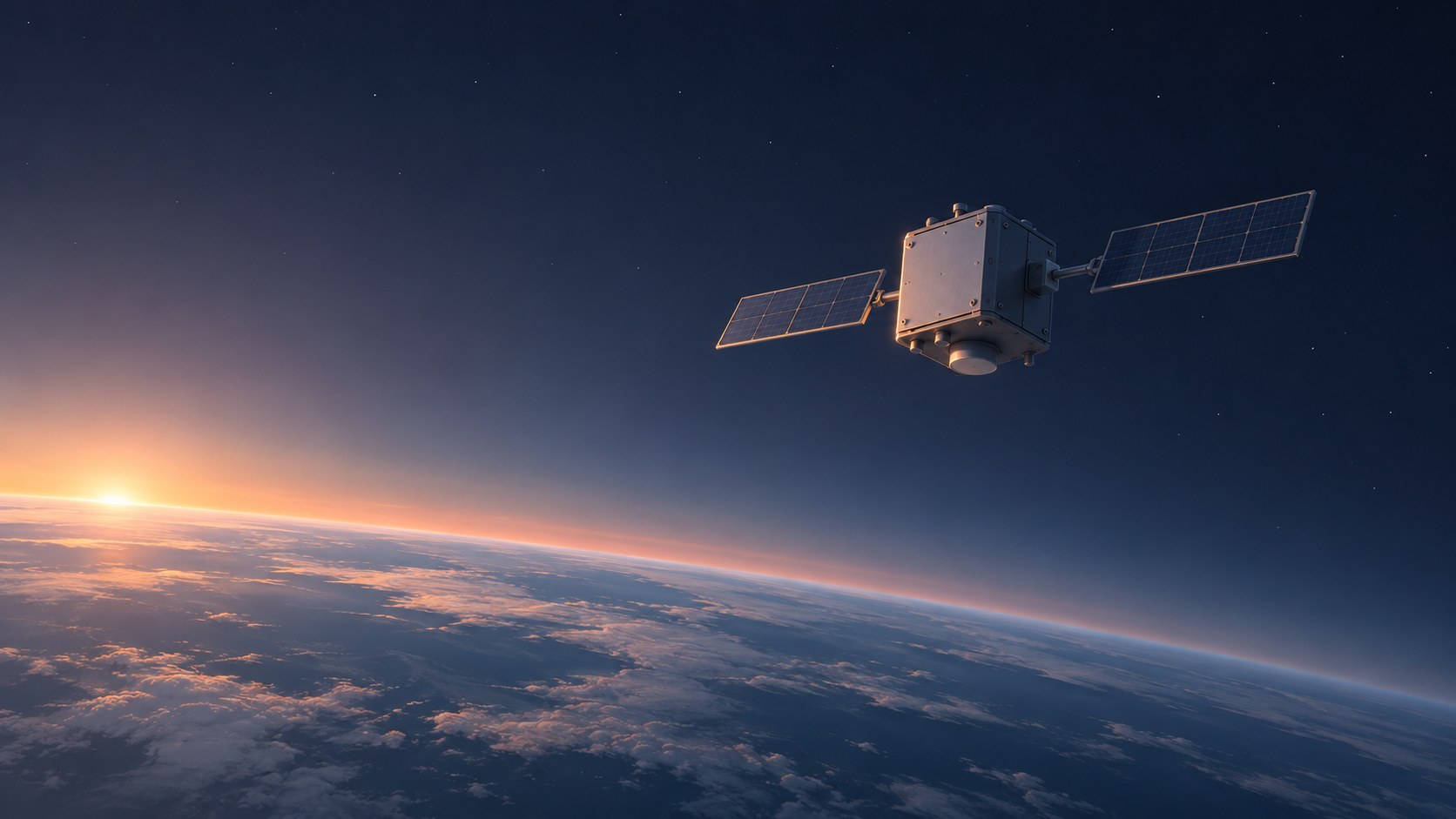
The flight would be the first dedicated heavy-lift launch for Google’s Project Suncatcher. Google says each planned satellite would have computing capacity roughly comparable to a data-center rack and would be placed in a sun-synchronous orbit. A target date and a capacity comparison are plans, not evidence that the planned system is already operating.
The agreement follows a much smaller prototype test. In October, Google said it had sent a prompt to an experimental satellite and received a response from a model running on a data-center-class Tensor Processing Unit, or TPU, in orbit. That milestone demonstrated an individual test, while questions about cooling, reliability, communications and cost remain open.
What Google and Blue Origin have agreed
Blue Origin’s announcement describes a launch-services agreement for the Suncatcher mission. The company’s New Glenn vehicle is intended to deploy satellites equipped for machine-learning computing. Google’s November 19 statement identifies the target as the first quarter of 2029 and calls the project a long-term research moonshot.
The companies describe the capacity of each satellite using the scale of a data-center rack. That comparison helps readers understand the ambition, but it is not a complete performance specification. A rack can contain different kinds of hardware and workloads, and useful comparisons would also need power consumption, communication capacity, reliability and the software being run.
Neither the announced launch date nor the stated design goal proves that a commercial orbital data center will be available in 2029. Rocket schedules and research programs can change. The announcement establishes that Google has selected a launch provider for a future mission; it does not report the mission as flown or the satellites as operational.
Why the rocket matters
Heavy-lift launch vehicles are designed to carry substantial payloads to space. For a project that may eventually require satellites, power systems and cooling hardware, the available launch mass and volume are important constraints. Blue Origin says New Glenn’s capacity gives customers flexibility in what they can send to orbit.
For Google, booking a dedicated launch is a step beyond the earlier prototype, which flew as part of a mission with another launch provider. It does not mean Google has stopped working with other partners. In its announcement, the company said the Blue Origin flight builds on ongoing work with satellite and launch partners.
What is Project Suncatcher?
Project Suncatcher is Google’s effort to investigate machine-learning computing in space. Its long-term concept involves satellites with solar power and Google-designed TPUs. Blue Origin describes an interconnected network as the research goal, while Google emphasizes using solar energy available in orbit to support computing infrastructure.
A TPU is a chip designed by Google for machine-learning workloads. Putting one on a satellite is not simply a matter of placing an ordinary server in a box and launching it. The system must survive launch, obtain electrical power, communicate with other equipment and operate in an environment with radiation and large temperature changes.
The project is best understood as a sequence of experiments. A single chip responding to a prompt is a useful early result. A connected group of satellites running reliably, exchanging data and handling demanding workloads would be a different and much larger achievement. A competitive commercial service would require still more evidence.
What the first prototype actually showed
Google said its prototype launched on October 1, 2026. In an October 30 update, the company said it had powered up equipment and run early machine-learning tests. During a ground-station pass, a prompt was sent to an onboard Gemma 4 model, and its response was received on Earth.
That result matters because it shows more than a chip merely surviving the journey. According to Google, the system received a command, performed a model task and returned an output. But a single reported response does not establish how often a satellite can perform demanding jobs, how it behaves over its intended life or how it compares economically with ground-based infrastructure.
Google said subsequent tests would examine how its TPUs perform under thermal stress and radiation exposure. It also identified twin interconnected satellites in 2027 as a next milestone. Those are plans and areas for testing, not results already demonstrated by the 2029 launch announcement.
- Completed, according to Google: a prototype launched in October 2026 and returned an initial model response.
- Next research step: continued testing of performance under orbital thermal and radiation conditions.
- Planned milestone: twin interconnected satellites in 2027.
- New launch agreement: a dedicated New Glenn mission targeted for the first quarter of 2029.
Why consider computing in space at all?
AI systems require computing hardware, and that hardware needs power and a way to remove waste heat. As demand for computing rises, developers of data centers must consider access to electricity, land, water and supporting infrastructure. Google’s proposal explores whether solar power in orbit could support some computing without placing all of that demand on a terrestrial site.
The idea is appealing because satellites can collect sunlight in suitable orbits and because space offers room for different kinds of infrastructure. Yet the availability of sunlight is only one part of the energy equation. The equipment must be manufactured, launched, operated and eventually managed at the end of its life. A claim about overall environmental benefit would require a full comparison of those factors.
Reuters reported that companies are exploring orbital computing as demand places pressure on infrastructure on Earth. It also noted launch costs, engineering hurdles and satellite production as obstacles. Those costs and constraints mean that a promising experiment is not yet a demonstrated replacement for conventional data centers.
The cooling problem is different in orbit
Powerful chips generate heat wherever they operate. On Earth, data centers use systems that transfer heat through air, liquids or a combination of methods. In orbit, a spacecraft cannot rely on the surrounding atmosphere to carry heat away in the same way. It must use hardware designed to move and radiate heat into space.
Reuters notes that engineers are studying cooling with pipes and panels rather than conventional airflow. Such systems add mass, take up space and must continue working through changing thermal conditions. The amount of useful computing a satellite can sustain will depend not only on the processor but also on how effectively the whole spacecraft manages power and heat.
There is a trade-off between running a chip hard and keeping its environment within safe limits. In an experiment, researchers can measure that trade-off over time. Before extrapolating to an orbital fleet, they would also need to understand how cooling systems perform as components age and as individual satellites operate under different conditions.
Radiation, reliability and repairs
Radiation in space can damage electronics or disturb data. A practical computing system therefore needs to account for errors, equipment degradation and the possibility that a component stops working. Google’s planned prototype tests are intended in part to study how TPUs perform under those conditions.
Reliability is not just a question of whether one chip starts successfully. A useful service must deal with failures across processors, memory, power systems and communications links. It must also preserve the integrity of the results it returns. The required safeguards can affect the amount of hardware, energy and time needed for a task.
Repair is another difference from a ground facility. A technician cannot simply walk up to an orbiting server and replace a failed part. Depending on the design, an operator might need redundancy, a replacement spacecraft or a different maintenance approach. The companies have not established from this announcement alone how such an operational system would be maintained.
Getting data to and from satellites
Computing capacity is useful only if work can reach it and results can be returned. A satellite may communicate with a ground station when the geometry permits, and a future network might connect satellites to each other. Each link introduces questions about throughput, availability, security and the time required to move data.
For some workloads, a delay between sending a request and receiving a result may be acceptable. For others, particularly interactive services or large transfers, the communications system could be a decisive limitation. These are engineering and product questions to be measured, not problems solved merely by putting a processor in orbit.
There is also a difference between running a model locally on a spacecraft and serving customers worldwide from a network of satellites. The first prototype result says little on its own about the capacity, coverage or availability of a future network. Those details would need to be demonstrated through later tests and published performance data.
What does sun-synchronous orbit mean?
Google says the planned satellites will enter a sun-synchronous orbit. In broad terms, such an orbit is arranged so a satellite passes over locations at a similar local solar time. The design can help missions plan around lighting conditions, although the precise sunlight available to a spacecraft depends on its orbit, configuration and season.
It would be inaccurate to assume that every satellite in this kind of orbit receives uninterrupted power, or that solar generation removes the need for storage and power management. The companies’ announcement does not provide a complete power budget for the planned spacecraft. More details would be needed to assess how much computing can be sustained.
What remains unknown
The announcement does not establish a final launch date, the precise number of satellites or a detailed cost for the mission. It also does not provide a full comparison of performance per watt, network capacity or lifecycle emissions against a terrestrial data center. Those omissions do not make the research unimportant; they define what cannot yet be concluded.
Commercial viability will depend on more than one successful launch. Manufacturing satellites at scale, buying launch capacity, ensuring reliable communications and replacing failed equipment would all affect costs. The comparison would also change as ground-based computing, renewable power and cooling technology improve.
There are wider questions about responsible use of orbit, including how satellites are tracked and managed at the end of their missions. Any future large deployment would need to operate within applicable rules and address those practical responsibilities. The November announcement is a launch agreement and does not establish a completed deployment plan at commercial scale.
What to watch next
The clearest near-term evidence will come from Google’s continuing prototype tests: whether the company publishes results on reliability, radiation, heat and useful computing over time. The planned interconnected-satellite milestone would also be a more meaningful test of networking than an isolated response.
For the New Glenn mission, watch for updates on the spacecraft design, launch schedule and eventual flight outcome. A booking can show intent, but payload readiness and launch availability both matter. Readers should distinguish a schedule update from a confirmed launch and a successful deployment from a long-running computing result.
Project Suncatcher’s ambition is significant: use solar-powered spacecraft to explore a new place for AI infrastructure. The evidence so far supports a more modest conclusion. Google reports one early orbital model response, and it has now selected Blue Origin for a larger future mission. Whether that research can become reliable, economical infrastructure remains to be tested.