Look at the outline of Dimorphos in the images the European Space Agency released on November 25, 2026. Along one side, the little asteroid looks as though someone sliced off the end. That flattened face is the crater left by NASA’s DART spacecraft, according to the Hera mission team. Four years after astronomers measured the change in the asteroid’s orbit, they can finally see where the spacecraft hit.
The detail is easy to miss if you go looking for a round hole in the middle of a photograph. In ESA’s annotated sequence, start with the framing-camera view and look toward the upper left of the moonlet. Then scroll to the comparison between DART’s view on approach and Hera’s view after impact. The surprising feature is the scale of the change on one face. Elsewhere, the familiar fields of boulders are still recognizable.
Why astronomers had an answer years before they had a picture
DART hit Dimorphos on September 26, 2022. The smaller asteroid circles a larger one called Didymos. That pairing gave observers on Earth a clock they could read from far away. As one asteroid passes in front of the other, the amount of sunlight reaching a telescope falls. A shadow cast by one body on the other can cause a dip too. Record enough of these events and their timing reveals how long the smaller body takes to complete a circuit.
Before DART arrived, one lap took about 11 hours and 55 minutes. Afterward, the dips came earlier. In their analysis of radar and telescope observations, Cristina Thomas and colleagues reported that two approaches returned the same change in the orbital period, a reduction of 33 minutes with an uncertainty of one minute. The measurement concerns Dimorphos going around Didymos. It is easy to lose track of that second asteroid when the headline says a spacecraft changed an orbit.
A clock can tell you that a collision changed the motion. It offers much less detail about the place where the spacecraft met the rock. DART’s camera had an excellent view of the approaching surface, but its recording necessarily ended at impact. For the equivalent of an after photograph, someone had to send another camera.
What a model could tell us about the missing surface
In the interval between the missions, researchers made use of the evidence they had. A 2024 study described by NASA’s Jet Propulsion Laboratory combined DART’s approach images with radar observations and the changing brightness of the asteroid pair. The team inferred that the moonlet had become more elongated. Its reconstruction also found that the orbital period continued to change in the weeks after the collision.
There is a good reason to keep that reconstruction alongside the new pictures. An outline inferred from a sequence of brightness measurements describes the overall shape that fits the data. A close-up can show which face has flattened and where the surface still looks much as it did before. An asteroid can undergo a large change in its outline while retaining recognizable terrain over much of its surface. Hera gives researchers a way to check both observations against the same object.
Why the displaced rock matters
Picture the simplest version of the experiment: a spacecraft hits an asteroid and stays there, with no material thrown clear. Thomas and colleagues estimated that direct transfer of the spacecraft’s momentum in that case would have shortened the orbital period by roughly seven minutes. The measured change was much larger. Their paper identified the recoil from material ejected in the collision as a likely contributor. Rock flying away carries momentum of its own, and the remaining body recoils in response.
Hera’s view gives that argument a physical setting. The mission team can examine the ground from which material was displaced. It has also spotted hundreds of boulders moving around the pair, some just a few metres across. A picture of a boulder in flight does not date its departure from the surface. For the people planning the spacecraft’s closer passes, however, the immediate question is where those objects are going, regardless of how they got there.
Three things to look for in the mission images
- The edge of the smaller body. Trace it before looking for the crater floor. A broad impact site seen from the side can change the silhouette more conspicuously than the shading.
- The orientation from frame to frame. ESA reports that the smaller body is tumbling as it travels around its companion. Following its position around Didymos and following which face points toward the camera are two different exercises.
- The instrument credit. A visible-light frame and a thermal image of the same pair can look remarkably different, particularly on the side facing away from sunlight.
That last distinction is visible in ESA’s comparison of Hera’s instruments. In one set of observations most of Dimorphos was in shadow. The visible-light view caught only a small sunlit patch, while Japan’s Thermal Infrared Imager picked up the moonlet across its disk. A surface that reflects little sunlight toward the camera can still emit heat. Watching how its temperature changes gives researchers another clue to whether they are looking at loose material or more solid rock.
For anyone following asteroid deflection, the two missions now offer an unusually good pair of records. The telescope data preserve the timing of the change. The camera sequence shows what became of the target. The next time a simulation produces an orbit that agrees with the 33-minute measurement, researchers have a harder question to ask of it: does it also leave behind an asteroid that looks like this one?
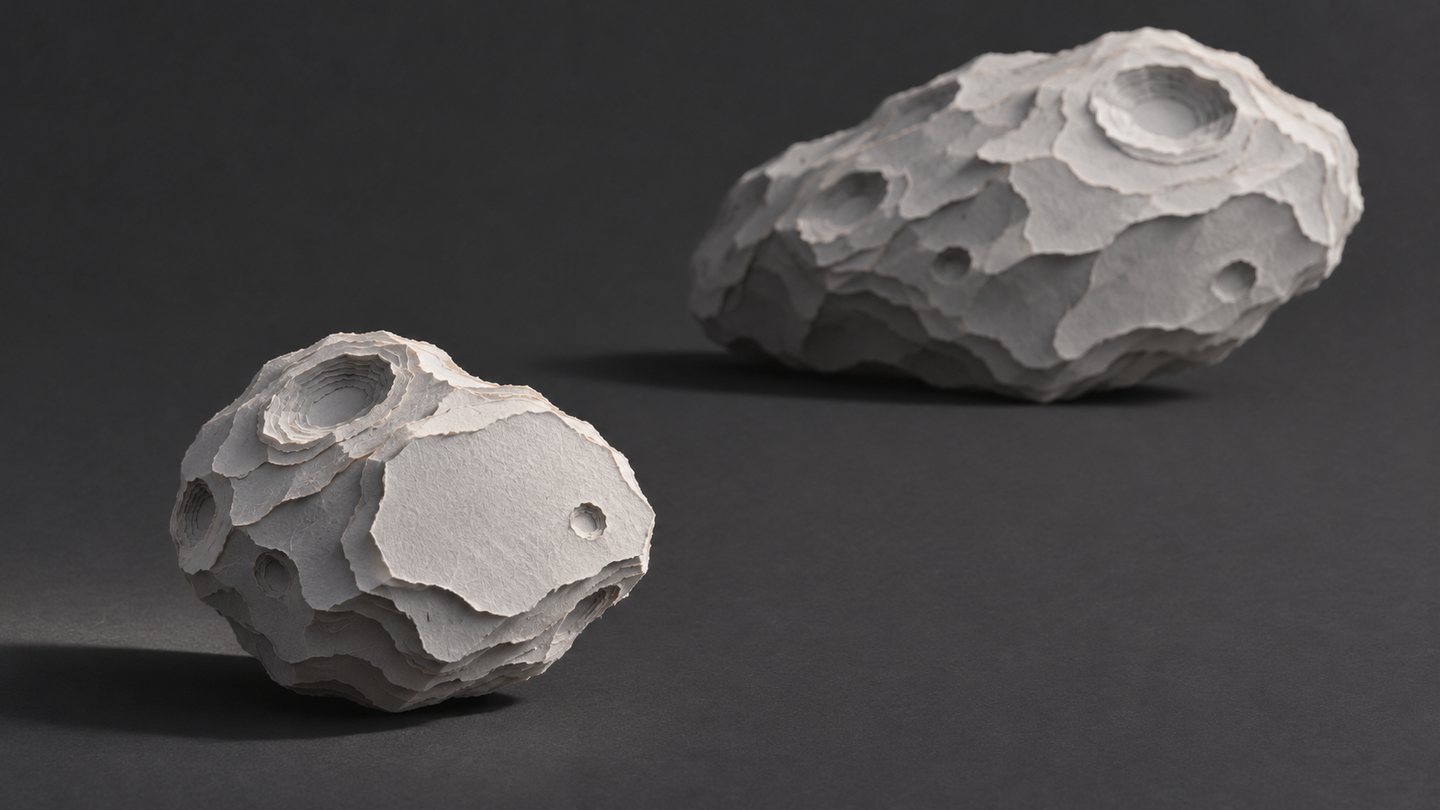
HotPotNews editorial illustration of two layered-paper asteroid models. The ESA links above show the spacecraft images.