
SpaceX recovered Starship’s upper stage at its Texas launch tower after an orbital flight, while the mission’s booster was lost. The first ship catch is a major test result, with important steps still ahead.
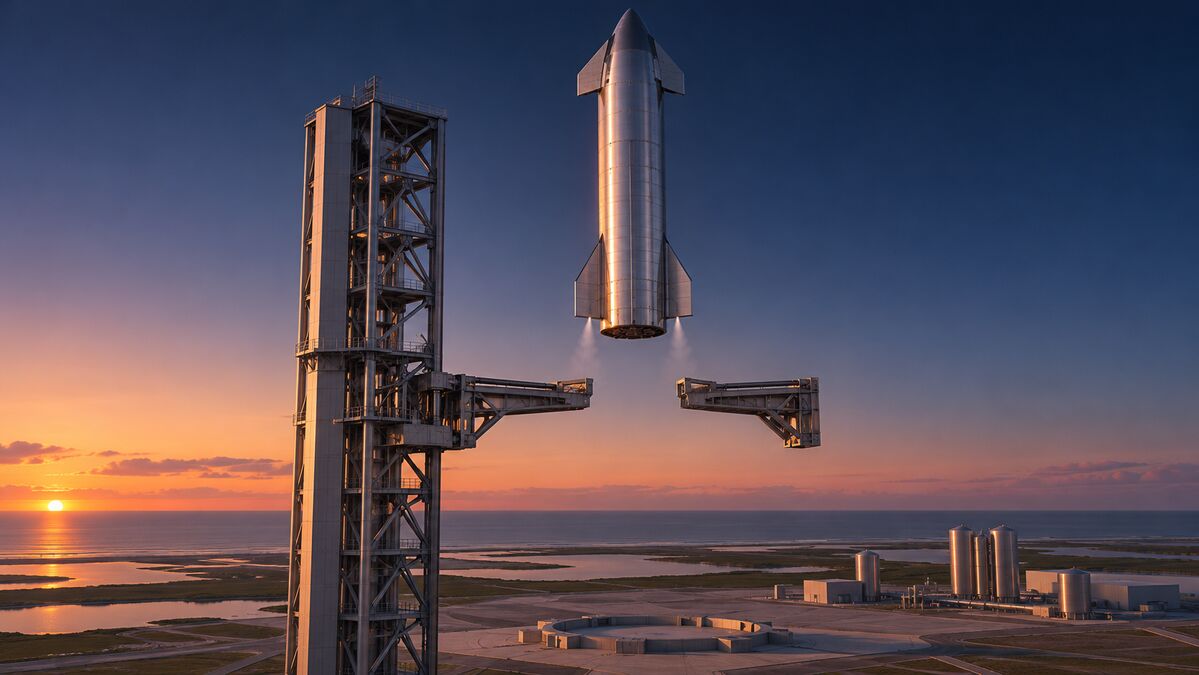
A return to the launch tower
SpaceX caught the upper stage of its Starship rocket with the mechanical arms of its Texas launch tower on November 14, 2026, after a flight that took the uncrewed spacecraft into orbit and back. It was the first time the company had captured the Starship spacecraft itself at the tower after a trip to space, a milestone in its effort to recover more of the vehicle.
The achievement came with a significant qualification. SpaceX had hoped to catch both the Super Heavy booster and the upper-stage spacecraft during Flight 15. The booster did not return to the tower: after an aborted catch, it was diverted toward the Gulf of Mexico and destroyed. The successful ship catch therefore demonstrated one part of the intended recovery sequence, not a complete double catch.
According to the Associated Press and specialist publication SpacePolicyOnline, the ship spent about 22 hours in space, completed 14 orbits and deployed 26 Starlink satellites before returning to Starbase. SpaceX’s published mission plan had identified both the satellite deployment and the first upper-stage return and catch as primary objectives.
What happened during Flight 15
The integrated vehicle lifted off from Starbase, Texas, on November 13. Starship is used both as the name of the upper-stage spacecraft and, informally, for the combined launch system. The large first stage is called Super Heavy. Separating those names matters because the two vehicles had different outcomes on this flight.
After stage separation, the booster began its return. AP reported that its engines stopped firing too soon and that the guidance system determined it was not in the correct position for a tower catch. The system diverted it toward the Gulf and initiated its destruction. SpaceX was still investigating the cause, according to the reporting.
The upper stage continued into orbit. AP reported that it released 26 advanced Starlink satellites and circled Earth 14 times. The spacecraft then reentered, approached the launch site and was caught by the tower’s arms on November 14. SpacePolicyOnline placed the catch at approximately 3:20 p.m. local Texas time.
These observations come from reporting on the flight and company coverage of the mission. They do not by themselves establish the condition of every component after landing, the cost of refurbishment or when this particular spacecraft could fly again. Those details require inspection and subsequent operational data.
Why catching the ship is different from catching a booster
SpaceX had previously caught Super Heavy boosters with tower arms. A booster return begins minutes after launch, while the upper stage on this mission first went into orbit and spent many hours in space. The ship then had to survive a much higher-energy atmospheric return before attempting its controlled approach.
Reentry exposes a spacecraft to intense heating as it slows through the atmosphere. Starship uses a thermal protection system on the side exposed during descent. AP reported that SpaceX said the spacecraft and its heat shield appeared to work well on this flight. A preliminary assessment is encouraging, but a detailed inspection is needed to understand wear and any repairs.
The tower catch itself brings a different set of challenges: the vehicle must navigate toward a fixed structure, control its speed and orientation, and enter the capture envelope of moving mechanical arms. The mission also requires the launch site to be ready for a returning spacecraft after the booster’s earlier departure.
What the tower arms do
The arms, often called chopsticks, are attached to the launch tower. They are intended to support a returning stage rather than require that stage to land on its own legs. SpaceX has already demonstrated the concept with boosters, but Flight 15 applied it to the Starship upper stage returning from orbit.
A tower catch is not simply a substitute for touching down on a pad. The vehicle, the arms, the launch structure and the control systems must all operate together. Even when a flight reaches the site, safety checks and guidance conditions can determine whether an attempted catch proceeds.
The booster diversion illustrates that point. The decision not to approach the tower when the vehicle was not in the expected position was part of the flight’s safety logic, according to AP’s account. It also meant that SpaceX did not meet the mission’s desired goal of recovering both stages.
What reusability means here
Recovering a spacecraft is an important step toward reusing it, but recovery and reuse are not identical. A vehicle can return intact and still require extensive inspection, repairs or replacement of components before another flight. The useful engineering question is how much work is needed between missions and whether that work can be performed repeatedly and safely.
SpaceX designs Starship for reuse of both the booster and the upper stage. Flight 15 adds an upper-stage catch to the company’s previous booster recoveries, but it did not recover both stages on the same mission. It is therefore too early to treat this flight as proof of routine, rapid turnaround of the entire system.
Cost claims also need evidence. Reusing hardware can reduce the amount of hardware discarded per flight, but the economics depend on production costs, flight rate, fuel, staffing, inspection, repairs and launch-site operations. SpaceX’s ambitions are clear; a single test does not establish a mature operating cost.
The 26-satellite deployment
AP and SpacePolicyOnline reported that Flight 15 deployed 26 Starlink satellites. The deployment gave the upper stage a real mission in orbit before its return. It also made the test more than a brief up-and-down flight: the spacecraft had to operate in orbit, release its payload and later execute its return sequence.
SpaceX’s mission description had listed the deployment of 26 Starlink V3 satellites as a primary objective. SpacePolicyOnline described the newer satellites as larger than earlier versions. The published mission plan and postflight reporting should be distinguished: a plan describes what the company intended, while postflight accounts establish which events were observed.
For the satellite business, a larger vehicle can change how much equipment a single launch can carry, but the benefit depends on repeated flight performance and operational reliability. The deployment on this mission is one data point; it does not establish the future launch cadence or commercial price of Starship.
Why the booster was lost
AP reported that the booster’s engines stopped firing too soon during its return and that the guidance system detected the vehicle was not in the right position. It diverted toward the Gulf rather than attempting a catch at the tower. The booster was destroyed, and debris remained in an area marked off in the Gulf, AP reported.
SpaceX was still investigating the underlying cause. That means there is a difference between the immediate sequence reported during the flight and a final engineering explanation. A guidance decision may be observable even while engineers are still determining why the vehicle reached the wrong state.
The result matters for the next phase of testing because the company’s long-term concept depends on recovering both major stages. Successful catches on separate flights demonstrate pieces of the approach, but a reliable system needs those pieces to work together repeatedly. Flight 15 did not provide a successful booster recovery.
The NASA connection
NASA has selected a Starship-based human landing system for Artemis lunar missions. A successful upper-stage return is relevant to the broader development program because it demonstrates another part of the vehicle’s flight and recovery capabilities. It is not the same as completing a lunar landing demonstration or certifying a crewed lander.
SpacePolicyOnline notes that the lunar landing version requires in-orbit refueling and that SpaceX has not yet demonstrated the required in-space transfer of cryogenic propellants. Refueling, long-duration operations, docking and landing-system tests are distinct milestones. A tower catch cannot substitute for those demonstrations.
NASA schedules and mission assignments can change. AP reported that the agency was targeting Artemis IV for a lunar landing as soon as 2028, while SpacePolicyOnline described a planned Artemis III orbital test involving Starship. Those are reported plans, not guarantees that future missions will launch on those dates.
A milestone, not the end of testing
Flight 15 delivered a striking combination: a booster loss followed by a successful orbital return and first catch of the upper stage. Both outcomes are necessary to understand the mission. Calling it either a complete failure or a complete demonstration of full-system recovery would omit a major part of what happened.
The next questions are practical. What will inspections reveal about the heat shield, engines and structure? What caused the booster’s return problem? How much work will be needed before a recovered vehicle can be prepared for another mission? Public answers to those questions will matter more than a single dramatic image.
Future flights will also need to demonstrate consistency. One successful catch proves that the maneuver can be performed under the conditions of this mission. Repeated successful flights, recovery of both stages and transparent evidence of turnaround will determine how close the system is to routine operation.
How to follow the program
Readers following Starship can compare SpaceX’s mission descriptions with independent reporting and NASA’s Artemis updates. Launch plans are often updated and can change because of vehicle readiness, weather, regulatory review or safety conditions. A scheduled test is not a confirmed flight.
Separating the booster from the ship in headlines also helps. The same mission can have different results for launch, payload deployment, booster recovery and upper-stage return. A clear account should identify which stage performed each action and which objectives were not met.
Flight 15’s clearest verified result is that an uncrewed Starship upper stage returned from orbit and was caught at Starbase on November 14. The investigation into the booster’s failure and the work needed to reuse the recovered ship remain part of the story still to come.
Sources and publication context
Reported November 15, 2026, from the Associated Press, SpacePolicyOnline, The Verge and SpaceX’s preflight mission plan. Mission goals are distinguished from postflight reporting.